
William & Mary launches nationwide training in LGBTQ+ affirming counseling
 Amber Pope, associate professor of Counselor Education at the School of Education, sought to fill a void in counselor education around the LGBTQ+ community. Identifying the need for training that goes beyond a broad overview to address the range of identities, experiences and evolving terminology that counselors encounter in their work, she led the development of a new, research-based LGBTGEQIAP+* affirming counseling training now available to mental health professionals nationwide.
Over the course of six asynchronous modules, mental health professionals can gain a deeper understanding of the LGBTGEQIAP+ population and greater confidence in how they approach and work with clients. Prior to launch, Pope and her collaborators conducted two program evaluation studies, first with master’s-level counseling students and then with early-career professionals. Both are published as open-access research articles in “Counselor Education and Supervision.”
Officially launched in May 2026, the William & Mary training has received positive reviews from practicing mental health professionals.
Joan Friedrich, Ph.D., LPC, praised its approach on LinkedIn: “I completed this training last weekend and I love it. It was more comprehensive than other LGBTQ+ trainings I have attended. I highly recommend it for master’s students, early career mental health professionals, as well as seasoned clinicians who lack knowledge about working with the LGBTQ+ community,” said Friedrich.
Sharon Rose Cappella, M.S., LPCA, a counselor and doctoral student who participated in one of the early program evaluations while earning her master’s degree, praised the program for increasing her knowledge, counseling skills and advocacy while strengthening her cultural humility, empathy and sensitivity toward the diversity of the LGBTGEQIAP+ community.
“I saved the extensive resources from the training, which I often refer back to when encountering a client within my practice who would benefit from my access to these resources. I use them as reference guides,” said Cappella.
Addressing an evolving need
LGBTGEQIAP+ is an area often overlooked or glossed over in educational and institutional settings for counselors, despite being a continually growing and increasingly visible population, said Pope. For example, she noted that according to a recent Gallup poll, approximately 20% of Generation Z identifies as part of the LGBTGEQIAP+ community, compared with about 10% of millennials.
In recent years, understanding of the expansive spectrum of sexual orientation and gender identity, along with the use of more individualized terminology, has grown. The training introduces participants to this diversity of identities and experiences, helping counselors recognize that the community cannot be understood through a single perspective or set of assumptions.
Pope found that many LGBTQ+ trainings provide a broader examination of sexual orientation, often focusing predominantly on lesbian and gay identities, while gender identity and the bisexuality and asexuality spectrums are consistently misunderstood or given less attention. To bring these topics to the forefront, the modules on gender identity appear earlier in William & Mary’s training than in other courses, where they are often treated as supplemental. Additionally, the training includes mini-modules on bisexuality and asexuality.
Another point this training underscores is that while cultural understanding is growing, this is not a new community but one that has existed throughout human history. One of the six modules focuses on history, current events and advocacy within the LGBTGEQIAP+ community.
“Individuals who have been on these spectrums, and not just on those binaries, have existed forever across the world,” said Pope. “We simply have a greater vocabulary and more terminology now to describe and understand people’s unique identities.”
Leading with cultural humility
Pope emphasizes that the ability to acknowledge and understand one’s own biases and knowledge gaps is an important factor in a counselor’s professional growth. Clients should not have to educate their counselors about their identities or experiences. Rather, counselors should take the initiative to seek information and become better informed.
The training heavily emphasizes the importance of cultural humility in LGBTGEQIAP+ affirming counseling, as well as the use of a person-centered approach. Cultural humility requires counselors to recognize their own limitations, remain open to learning and understand that no two clients have the same lived experience. It also means approaching each person with curiosity rather than assumptions.
When asked about the most important behavior or approach a counselor can bring to affirming care, Pope emphasized unconditional positive regard as essential to building a strong therapeutic alliance.
“Engaging in micro-affirmations is so important – using someone’s identity terms, name or pronouns. If you tell me your name, I just use your name. There’s no question about it,” Pope explained. Small actions like these communicate acceptance and affirm clients’ personhood. Micro-affirmations allow clients to show up authentically as themselves.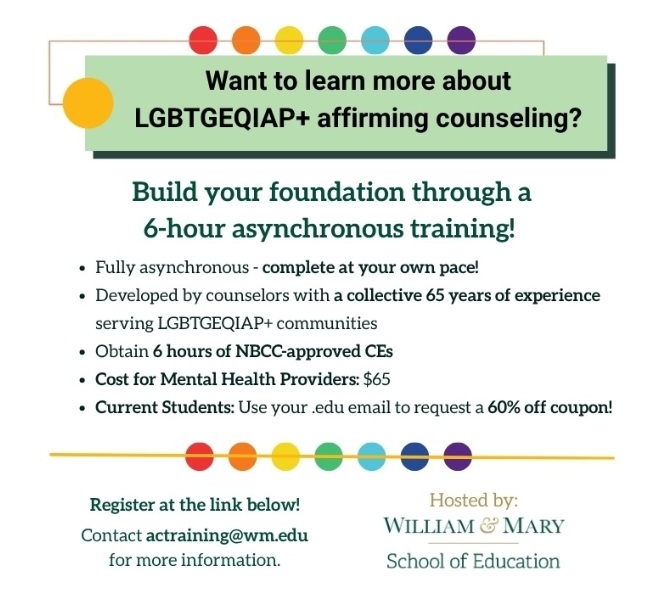
Pope said some of the most rewarding feedback from participants has come from people who, despite identifying as members of the LGBTGEQIAP+ community themselves, discovered they still had more to learn about the experiences of others in the community.
“A lot of people have said, ‘Oh, this made me stop and think,’” Pope recalled. Some participants recognized that their own lived experiences were not enough to prepare them to work with every client or understand every identity. For Pope, seeing participants challenged to think differently has been one of the most meaningful responses to the training.
Pope’s overarching message to take away from the training is simple: “Just be curious about that person’s world. That’s really what a lot of affirming counseling is based on. Just be with the human across from you.”
The Introduction to LGBTGEQIAP+ Affirming Counseling training is available to mental health professionals nationwide. W&M counseling students may participate for free, and counseling students from any university can request a substantial discount.
Learn more and register: Introduction to LGBTGEQIAP+ Affirming Counseling Training
*LGBTGEQIAP+ is an expanded acronym developed by SAIGE, a division of the American Counseling Association.
Editor’s note: Dulcinea Russell ’M.Ed. ’28 and Kimberly Richards-Thomas contributed to this article.