
Interdisciplinary research on AI in K-12 Education earns GRI Accelerate funding

As William & Mary’s Global Research Institute (GRI) announced in April, GRI has awarded a $300,000 Accelerate program grant to support a project led by Yixuan (Janice) Zhang, assistant professor of computer science, and Professor of Science Education Meredith Kier. Their interdisciplinary partnership explores how artificial intelligence can enhance science and mathematics learning in K-12 classrooms while advancing inclusivity, instructional quality and student critical thinking.
The work builds on prior National Science Foundation-funded research and focuses on translating advanced AI tools into classroom practice, with attention to teacher decision-making, ethical use and student engagement. Central to the project is an AI-powered collaborative platform developed by Zhang in partnership with researchers at George Mason University. The platform features AI “peer buddies,” virtual collaborators that engage alongside students during problem-solving tasks. Rather than providing answers, the AI prompts reasoning, encourages reflection and supports deeper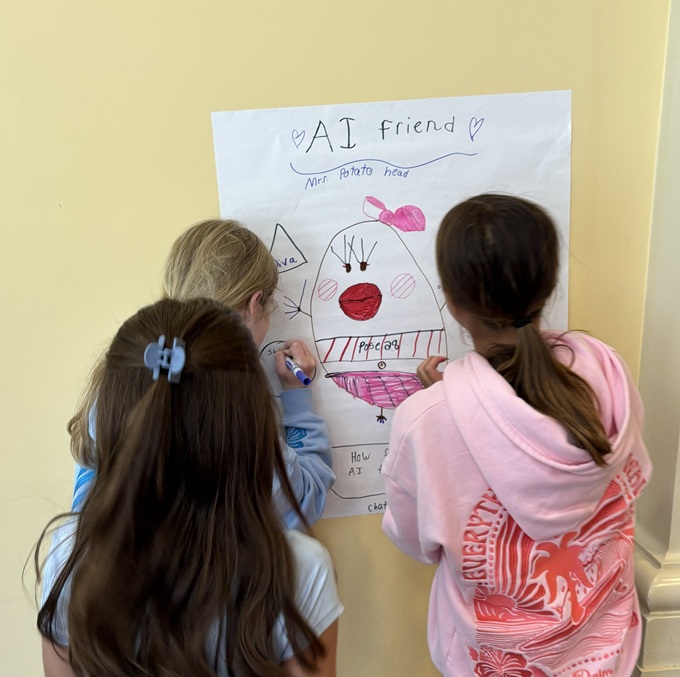 exploration of scientific and mathematical concepts.
“We want to make sure our students are seeing AI as a thought partner, or a tool that can support the development of their thinking rather than just giving them an answer,” Kier said. “They should not immediately trust what they see as output, but learn to critically evaluate those responses.”
The GRI Accelerate funding allows the research team to bridge the gap between technological innovation and classroom implementation. While the AI platform originated in computer science research, the project places it in real school settings to examine how teachers and students interact with AI tools over time.
“My work focuses on leveraging university–school partnerships to design and implement instructional and technological innovations that expand equitable opportunities for all students,” said Kier. Through partnerships with Williamsburg-James City County Public Schools, the team is working with educators across K-12, with a focus on middle and high school STEM classrooms. Elementary teachers receive support in using generative AI for lesson planning, while student-facing AI use is concentrated at the secondary level, where content complexity aligns with the technology.
Ensuring that AI does not deepen existing inequities is a central goal of the project. Differences in device access, district policies, privacy concerns and platform restrictions all influence how students experience AI-supported learning.
“Access to AI tools is not evenly distributed, which makes teacher preparation essential to ensuring equitable opportunities for all students, said Kier. “Teachers are really central to this work, and I do not see AI replacing their instructional decision making.”
Emphasizing teacher-guided use, critical evaluation of AI-generated content and explicit instruction in questioning and verification, the project includes professional learning resources to help educators determine when and how AI can support, rather than replace, student thinking. As AI becomes more widespread, teachers report uncertainty about maintaining academic rigor, protecting student data and navigating varied district policies. By studying AI use across multiple contexts, the project aims to develop adaptable frameworks, instructional materials and professional development models that respond to different levels of access and policy environments.
“Ultimately, the goal is to make sure these technologies expand opportunities for students and teachers, not limit them,” said Kier. With its focus on classrooms, teachers and school systems, the project aligns perfectly with GRI’s focus on applied, impact-driven research. The work seeks to produce findings that are both rigorous and scalable in schools and classrooms across the country.
“Our goal is not simply to produce knowledge,” Kier said. “It is to produce research that informs practice in ways that are responsive to local contexts and scalable across settings. Because AI is here to stay, we have a responsibility to ensure students and teachers engage with these tools in ethical, critical and intellectually rigorous ways.”