
Counseling Students Explore Community, Connection and the Impact of Taking Small Steps
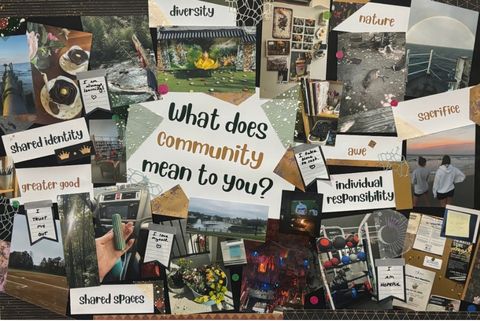 What does community mean to you?
For students in William & Mary’s on-campus counseling program, this question became the starting point for a summer exploration of connection, reciprocity and the small actions that can strengthen communities. As part of a summer course, the students participated in a Photovoice project, using photography, reflection and group dialogue to consider what community looks like and how it is created.
“I developed this project to integrate a service-learning activity within a 5-week semester, designed to connect what students are learning throughout their master’s program with activities or advocacy to address community needs,” said Associate Professor Amber Pope.
“Photovoice is a participatory action research method that also can be implemented for community engagement or inform program development, so students could potentially use this process for research or civic engagement within their clinical work,” added Pope.
The project’s focus is particularly fitting during William & Mary’s 2026 Year of Civic Leadership. The university describes civic leadership as placing knowledge in service of the common good and calls on members of the W&M community to steward their communities through service and integrity.
The Photovoice project offers a tangible example of those principles in action by inviting students to recognize the civic potential of everyday choices: noticing the spaces we inhabit; contributing to them; listening to others; and creating opportunities for the next person to participate.
Over the course of the project, students identified “third spaces” beyond home, work or school where people gather, connect and build relationships. As they reflected, the emphasis on small gestures became central to the students’ understanding of community. They then made individual contributions to spaces of their choice and photographed those contributions as a way of documenting community in action.
“I often thought of community engagement as days-long, intensive projects and contributions to local organizations. This project revealed to me that I can interact intentionally with my campus community and neighbors through small gestures,” said Sydney Pennix M.Ed. ’27. “With this project, if we have made one person smile or feel hopeful, we have succeeded in our work.”
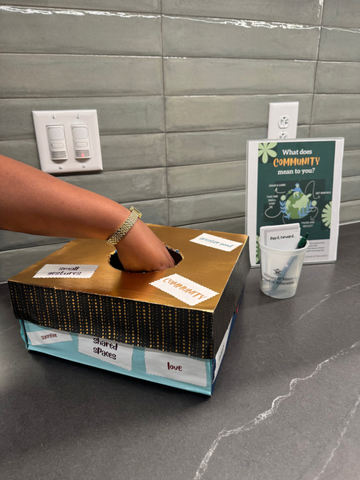 In addition to taking photos and creating collages, students created a series of small, shoebox-sized “community” boxes to encourage others to participate. Each box contains cards featuring affirmations, inspirational quotes, notes of gratitude and easy meal ideas. The reverse side offers simple actions people can take to “pay it forward” and cultivate community in their own corner of Williamsburg. The boxes contain instructions inviting visitors to draw a card, get inspired, take one small step, pause and reflect, and create a card to inspire the next person.
Pennix and her classmate Trinity Tannous M.Ed. ’27 chose Swem Library as their third space.
“We recognize that community is often found in the library in the form of group work, mentorship and general quality time with peers. We wanted to connect with students who may feel overwhelmed or stressed with coursework, and we hope that these interactive boxes provide encouragement, playfulness and meaning to students,” she said. 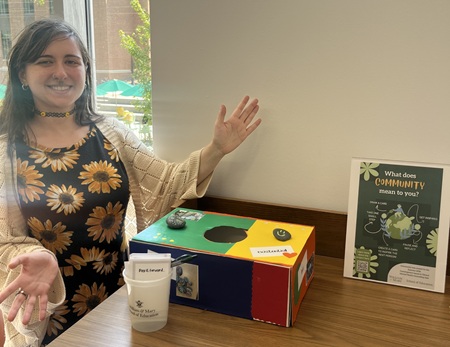
The students’ reflections are captured in a series of photo collages now displayed on the second floor of the School of Education near the student lounge. The collages bring together photographs, words and other representations of community, including images of food, nature, shared spaces, churches and campus gathering places alongside affirmations such as “I am enough” and “I trust my gut.”
As the students explored the connections that create community, Pope was struck by how often food became the focus.
“This was a good reminder of how food is a source of connection and community that we may neglect in our modern U.S. society where less of our lives are organized around shared meals,” she said. “Food is a means many of us have readily available to create opportunities for connection, as well as share aspects of ourselves and identities with those in our communities.”
Together, the photo collages illustrate that community can be both a physical place and an intentional practice. The photographs highlight shared spaces and moments of connection, while the affirmations underscore another dimension of community: the ways people can support one another’s well-being through encouragement, care and recognition.
On campus, boxes have been placed in the School of Education’s Inclusive Excellence office, the Flanagan Counselor Education Clinic, the Office of Student Veteran Engagement in Sadler Center, Swem Library, The Haven, the Student Center for Inclusive Excellence, the Bee McLeod Recreation Center and the McLeod Tyler Wellness Center. In the Williamsburg community, boxes are available at Complete Therapeutic Solutions, 1607 Coffee House and Williamsburg United Methodist Church.
Through photography, conversation and action, the students have turned the initial question into an invitation. What small steps can you take to help create a sense of community? For Pennix, that question will inform her work as a counselor.
“This highlights how vital belonging and connection are to each person. We all have different ways of contributing to the world around us, and we can all be encouraged to pass those kind gestures and messages along, even when life feels overwhelming,” she said.